
 Freestanding Vanities
 Floating Vanities
 Vanity Countertops
 Linen Cabinets
 Mirrors
 Vanity Organizers
 Shower Doors
 Shower Wall Panels
 Shower Faucets
 Shower Base Pans
 Shower Drains
 Bathtubs
 Tub Faucets
 Toilets & Bidet Seats
 Bathroom Sinks
 Bathroom Faucets
 Bathroom Accessories
 RTA Kitchen Cabinets
 Door Samples
 Cabinet Organizers
 Kitchen Sinks
 Kitchen Faucets
 Sink Grids
 Sink Drains
 Sink Accessories
 Appliance Hardware
 Range Hoods
 Floating Shelves
 Corbels & Decorative Wood
 Flooring
 Tile
 Mosaics
 Tile Installation Supplies
 Flooring Samples
 Stone Slabs
 Slab Samples
 Laminate Sheets
 Decorative Wall Panels
 Stacked Stone
 Moldings
 Exterior Siding
 Outdoor Pavers
 Pool Copings and Stair Treads
 Pebbles and Landscape Stone
 Cabinet Handles
 Functional Hardware
 Closet Organizers
 Bedroom
 Living Room
 Dining


SPC, LVP and laminate all look like wood on top; the difference is the core underneath. SPC (stone plastic composite) is a rigid, waterproof vinyl plank with a stone and plastic core, LVP here means a thin, flexible vinyl plank that's glued down, and laminate is a photo of wood over a pressed wood fiber core that's water resistant, not waterproof. At KBF, SPC runs about $2.16 to $3.90 a square foot for the material, glue down LVP about $2.07, and laminate about $3.70 to $4.94. For kitchens, bathrooms, laundry rooms and concrete slabs, SPC is the safe pick; laminate is a good choice for dry rooms if you like its harder, more wood like surface.
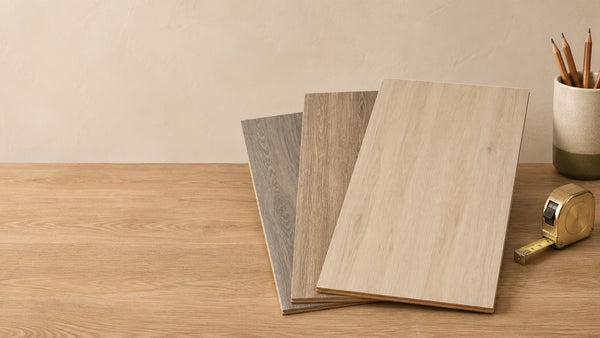
Someone had three samples lined up on the counter at the showroom, all the same pale oak color, and asked me which one was the real wood. None of them, which got a laugh. One was SPC, one was laminate, and one was a thin glue down vinyl plank, and from standing height they looked like the same floor. Then she picked them up, and one of them bent in her hand.
The trouble is that every label in this aisle says some version of durable, scratch resistant and realistic, and the names don't help. LVP, SPC, WPC, rigid core, luxury vinyl. What decides whether the floor survives a dishwasher leak or a dropped cast iron pan is the stuff you can't see once it's down.
So this is what I walked her through: what's inside each one, what the spec sheet numbers mean, and which rooms each one belongs in. SPC is what we sell the most of, and it's also the floor people most often put in their cart and then leave sitting there, so I'm guessing these are the questions holding people up.
SPC, LVP and laminate: what each one is made of
SPC stands for stone plastic composite. The core is powdered limestone mixed with PVC, which is the same plastic used in vinyl, pressed into a stiff board. On top of that sits a printed wood image and a clear wear layer, and on most of our SPC lines a thin foam pad comes glued to the bottom. People also call it rigid core vinyl or rigid core LVP, because technically it's a kind of luxury vinyl plank. It's heavy and stiff, it clicks together, and it floats, which means it isn't nailed or glued to the subfloor. It just sits on top and holds itself together at the joints.
LVP means luxury vinyl plank, and the term gets used for a lot of things. When we list a product as LVP on our site, we mean the older, thinner style: a flexible vinyl plank about 2 mm thick that's glued to the floor. It's all vinyl, so there's no wood in it to swell, but it has no stiff core, which means every little bump in the subfloor shows through. It needs a flat, smooth floor underneath and a glue down install.
Laminate has a core of HDF, or high density fiberboard, which is wood fiber pressed very hard with resin. A photo of wood goes on top, and a hard, clear top layer protects it. Good laminate today is a lot more water resistant than it used to be, with waxed or sealed edges, but the core is still made of wood fiber, and wood fiber swells if water sits on it long enough.

Side by side: thickness, wear layer, water and price
Here's how the three compare on our current lines. Price per square foot is the box price divided by the square feet in the box, for the flooring only, not trim, tax, shipping or install.
| SPC (rigid core) | Glue down LVP | Laminate | |
|---|---|---|---|
| Core | Limestone powder and PVC, stiff | Solid vinyl, flexible | HDF, pressed wood fiber |
| Total thickness on our lines | 5 to 8 mm, usually with the pad | 2 mm | 12 mm |
| Wear protection | 12 or 20 mil clear wear layer | 12 mil clear wear layer | AC4 or AC5 rated top |
| Water | 100% waterproof | All vinyl, no wood to swell | Water resistant, rated 72 to 300 hours |
| Pad | Attached foam pad on most lines | None, glued down | None, add underlayment |
| Install | Click together, floats | Glued to a flat floor | Click together, floats |
| KBF price per sq ft | About $2.16 to $3.90 | About $2.07 | About $3.70 to $4.94 |
Those price ranges come from real products. NASA New Columbia SPC is $65 for a 30.14 square foot box, about $2.16 a foot. Rio Grande Danube SPC is $85 for 30.18 square feet, about $2.82. Roman Hermes is $80 for 22.60 square feet, about $3.54, Isla Tahiti is $85 for 22.64, about $3.75, and Bar Harbor is $70 for 17.97, about $3.90. On the laminate side, 7 Kingdoms Castle Rock is $80 for 21.61 square feet, about $3.70, and Lakeview Echo is $115 for 23.29, about $4.94. The 819-6 glue down LVP is $110 for a 53.1 square foot box, about $2.07.
One thing worth knowing when you compare: the box price alone can fool you. Bar Harbor is $70 a box, less than Roman Hermes at $80, but a box of Bar Harbor covers 17.97 square feet and a box of Hermes covers 22.60, so per square foot Bar Harbor costs more. Always divide by the square feet in the box.


Wear layers and thickness, in plain words
The wear layer is the clear coating on top of a vinyl plank, the part your shoes and the dog's nails actually touch. It's measured in mil, and a mil is a thousandth of an inch, not a millimeter, which trips a lot of people up. A 12 mil wear layer is about 0.3 mm thick and a 20 mil wear layer is about 0.5 mm. Our NASA and Rio Grande SPC lines have 12 mil; Roman, Isla, Planet, Oasis and Bar Harbor have 20 mil. For a bedroom, 12 mil is plenty. For a kitchen, a hallway, or a house with a big dog, I'd go 20.
Laminate doesn't list a wear layer in mil. It uses an AC rating instead, which stands for abrasion class, a test of how well the top resists wearing through. AC4 is rated for commercial use and AC5 is a step above that. Our 7 Kingdoms laminate is AC4 and Lakeview is AC5, and either one is more than a house will ask of it.
Thickness is where the spec sheets get slippery. A lot of SPC lists a total thickness that includes the attached pad. Bar Harbor says 8 mm, and that's a 6 mm core plus a 2 mm pad. Rio Grande Danube says 5 mm, which is a 4 mm core plus a 1 mm pad. So when you compare two SPC floors, read past the headline number to the core thickness. A thicker core bridges small dips in the subfloor better and feels more solid underfoot, though it doesn't make the floor any more waterproof, since the core is waterproof either way.
Waterproof vs water resistant
Waterproof means the plank itself won't swell or come apart from water. SPC and vinyl are plastic, so water sitting on them doesn't hurt the boards. Water resistant means the boards can handle water on the surface for a rated amount of time before it starts to get into the core. Our 7 Kingdoms laminate is rated up to 72 hours of standing water, and Lakeview is rated up to 300 hours, which is a lot better than laminate used to be.
Here's the part people miss: waterproof planks don't make the floor underneath waterproof. If a dishwasher leaks for a week, water can still run through the joints and sit on the subfloor under even a perfect SPC floor. The planks will be fine. The plywood under them may not be. So waterproof flooring buys you time and saves you from swollen boards, it doesn't replace fixing the leak.
With laminate, the clock matters. A spill you wipe up is nothing. A toilet that runs over while you're at work, or a slow leak behind the fridge, can sit long enough to swell the edges, and swollen laminate doesn't go back down. That's why I put laminate in kitchens only with a note to wipe spills fast, and I don't put it in full bathrooms or laundry rooms at all.
Dents, scratches and sound
Dents come from weight on a small spot: a fridge leg, a piano, a chair with skinny metal feet. A rigid SPC core spreads that weight out better than thin glue down vinyl, which is soft enough to take a mark from a heavy point load. Laminate's top is very hard, so it shrugs off scratches, but the wood fiber core can crush under a lot of weight. For all three, felt pads under furniture legs and a wide caster under anything that rolls do more than any spec sheet number.
Sound comes in two kinds, and the spec sheet gives a number for each. IIC, impact insulation class, is footsteps and dropped things heard in the room below. STC, sound transmission class, is voices and the TV traveling through the floor. Higher is quieter for both. Isla Tahiti is rated IIC 68 and STC 69, Bar Harbor IIC 73 and STC 72, and Rio Grande Danube, with its thinner 1 mm pad, IIC 52 and STC 67. If you're upstairs over a bedroom or in a condo with rules about floor noise, that IIC number is the one to check, and some buildings ask for a minimum, so get that number from your HOA before you order.
Then there's the sound in the room itself. A floating floor can sound a little hollow when you walk on it in hard shoes. The attached pad on SPC helps a lot with that. Laminate and our engineered wood come without a pad, so you add underlayment, which is a separate foam or felt sheet rolled out before the planks go down. Glue down vinyl is quiet in the room, since it's stuck down, but it does nothing for the room below.
Which floor for which room
This is how I'd sort the rooms, based on the waterproof or water resistant rating and whether the floor has a pad.

Kitchens: SPC is the easy answer. Laminate works if you're good about spills and you love how it looks, and I'd pick the Lakeview line with its 300 hour rating over a 72 hour one here. Bathrooms and laundry rooms: SPC or vinyl, not laminate, not wood. Basements and concrete slabs: SPC floats right over concrete, but concrete gives off moisture, so read the install guide on the product page; many ask for a moisture test or a plastic vapor barrier under the floor. Glue down LVP needs the slab ground smooth first. Bedrooms and living rooms: anything works, so pick on looks and feel. Upstairs: SPC with an attached pad, or laminate with a good underlayment, and check the IIC numbers if anyone lives below you.
One more thing that decides it for a lot of people: if you want one floor running through the kitchen, the hall and the half bath without a strip at every doorway, SPC is the one that's allowed in all of those rooms.


When to step up to engineered wood
If what you really want is wood, engineered wood is the step up. It's a real hardwood top glued to a plywood core, so it looks and feels like wood because it is. Our Playa Grande line has a 3 mm European oak top over a eucalyptus plywood core, 9/16 inch thick in total, in 7 1/2 inch wide planks up to 6 feet long. It runs $270 for a 31.09 square foot box, about $8.68 a square foot, so roughly two to four times what SPC costs.
What you get for that is a floor that feels warmer and quieter underfoot, with grain that's actually wood, wire brushed so you can feel it. What you give up is water. It's real wood on top, so I'd keep it out of bathrooms and laundry rooms, and in a kitchen you'd treat it like any wood floor. It can be glued, nailed or floated, so it works over most subfloors, and there's no pad attached, so plan on an underlayment if you float it.
A lot of houses split it, and I think that's the smart version: engineered wood in the living room and bedrooms where you want it to feel nice, SPC in the kitchen, baths and laundry where water happens.
She went with SPC, Roman Hermes, through the kitchen and down the hall. Mostly it was the 20 mil wear layer and the fact that she wouldn't have to think about the dishwasher, though I think the 60 inch planks sold her too. She took the laminate sample home anyway, for the bedrooms, which is how a lot of these end up.
Free itemized flooring quote
Send your room measurements and a few photos to sales@kbfhomeimprovement.com. We reply in 1 to 2 business days with the box count, trim and a price for the floors you're comparing. Want to see them first? Order samples and put them on your own floor.
Frequently asked questions
Is SPC the same as LVP?
SPC is a kind of luxury vinyl plank with a rigid core made of limestone powder and PVC. When people say LVP they often mean the thinner, flexible vinyl plank, which is glued down. SPC is stiffer, clicks together and floats, and most of our SPC lines come with a pad attached.
Is laminate waterproof?
No. Laminate is water resistant. Its core is pressed wood fiber, which swells if water sits on it long enough. Our laminate lines are rated for 72 to 300 hours of standing water on the surface, which is fine for spills you wipe up but not for bathrooms or laundry rooms.
What is a wear layer on vinyl flooring?
It's the clear top coating that takes the wear from shoes, pets and furniture. It's measured in mil, a thousandth of an inch. A 12 mil wear layer is about 0.3 mm and a 20 mil wear layer is about 0.5 mm. For kitchens, halls and homes with pets, 20 mil is the better pick.
How much does SPC flooring cost per square foot at KBF?
Our SPC runs about $2.16 to $3.90 a square foot for the material, based on box price and square feet per box. For example, NASA New Columbia is $65 for a 30.14 square foot box and Bar Harbor is $70 for a 17.97 square foot box. Trim, tax, shipping and install are extra.
Can SPC go over concrete?
Yes. SPC floats over concrete, which is one reason it's popular for slabs and basements. Concrete can give off moisture, so follow the install guide on the product page, which may call for a moisture test or a vapor barrier under the floor.
Do I need underlayment with SPC flooring?
Most of our SPC lines have a foam pad attached, so you don't add a second foam pad. Over concrete, the install guide may still ask for a thin vapor barrier. Laminate and our engineered wood have no pad, so those need a separate underlayment.
Is engineered wood better than SPC?
It's a different thing. Engineered wood has a real wood top, so it looks and feels like wood and costs more, about $8.68 a square foot for our Playa Grande line. SPC is waterproof and works in kitchens, bathrooms and laundry rooms, where engineered wood doesn't belong.
Keep Reading
 RTA Cabinet Cost Per Linear Foot: A Budgeting GuideRTA kitchen cabinets cost $115 to $305 per linear foot at KBF. How a 10 by 10 kitchen is counted, four tiers priced, and what counters an...Read Guide
 PVC vs SPC vs Composite Marble Shower Wall PanelsWhat PVC, SPC, SMC, composite marble and porcelain shower wall panels are made of, how thick and big they are, how they go up, and what a...Read Guide
 Small Bathroom Vanity Ideas That Actually FitA size-first guide to small bathroom vanities: floating, narrow, shallow, corner and pedestal-replacement options with real inches and pr...Read Guide